
Signs of a Sick Magnolia Tree in Arlington, Texas
Southern magnolias are prone to one problem above all others in Tarrant County's alkaline soil. How to tell chlorosis from disease, and what to do about each.
Updated 2026-09-08 · Tree Service Pros
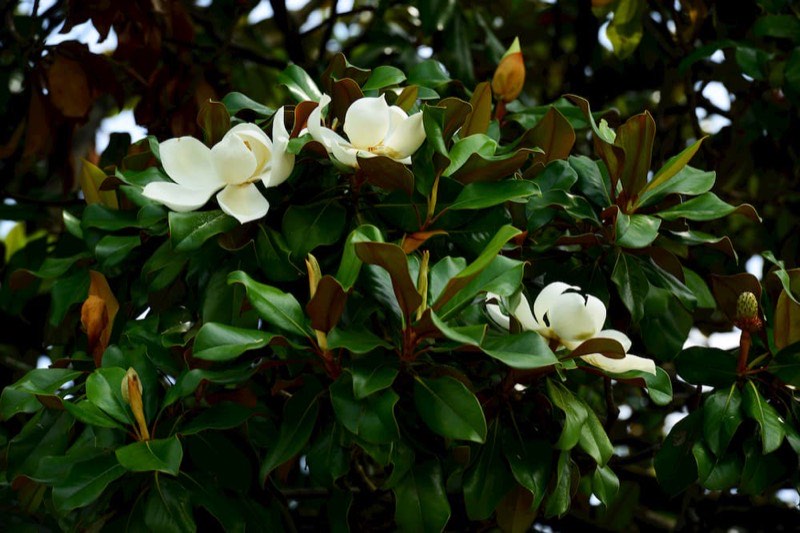
Most sick magnolias in Arlington have the same problem
Southern magnolia is a beautiful, appropriate tree for North Texas with one significant caveat: it wants slightly acidic soil, and Tarrant County's runs alkaline — commonly pH 7.8 to 8.3 over the Fort Worth Prairie. At that pH iron and manganese are chemically present but biologically unavailable.
The result is iron chlorosis, and it is by a wide margin the most common magnolia complaint we see. The signature is unmistakable once you know it: leaves turn yellow between the veins while the veins themselves stay distinctly green. Newest growth shows it first and worst.
Chlorosis versus actual disease
Yellow between green veins → chlorosis
Soil chemistry, not a pathogen. Treated with chelated iron — soil-applied for mild cases, trunk-injected for severe ones — plus, longer term, sulphur or acidifying amendments to move the root-zone pH. Do not reach for general fertiliser; it does not address the problem and the nitrogen can push soft growth a stressed tree struggles to support.
Uniform yellowing, oldest leaves first → normal, or nitrogen
Magnolias shed a flush of old interior leaves every spring. Yellowing on the oldest leaves only, with the canopy otherwise fine, is usually just that.
Black sooty coating on leaves → scale insects
Sooty mould grows on honeydew excreted by magnolia scale. The mould is cosmetic; the scale is the actual pest. Treat the insects and the black disappears over a season. Look for small bumps on twig undersides.
Brown or black leaf spots, especially after a wet spring → fungal leaf spot
Usually cosmetic on an established magnolia. Rake up and dispose of fallen leaves, improve air movement with careful thinning, and avoid overhead irrigation.
Wilting whole branches, dark streaking in the wood → verticillium wilt
Soil-borne, no cure, and the tree may or may not compartmentalise it. Reduce stress, remove affected wood, and do not replant a susceptible species in the same spot.
Culture beats chemistry
- Magnolias hate wet feet. Check drainage before adding water.
- Keep the root flare exposed — buried flares rot, and magnolias are often planted too deep.
- Mulch out to the drip line if you can; magnolias resent lawn competition and string-trimmer damage.
- Do not over-prune. Magnolias flower on the previous season's wood and heavy cutting costs you bloom for years.
If the leaves are yellow with green veins, you very likely have a soil problem with a straightforward fix. Our Arlington diagnosis visit is free and we will tell you which of the above you are actually looking at.
Tree Service Pros provides tree trimming, removal, stump grinding and land clearing across Tarrant, Johnson, Parker, Hill and Bosque Counties. Estimates are free — (817) 508-9940 or request one online.
More from the blog
Tree Surgeons in Fort Worth: What the Term Actually Means
“Tree surgeon” is a job description, not a credential. Here is what to look for instead when you are hiring someone to work on a tree in North Texas.
Read →Choosing a Tree Removal Company in Fort Worth: A Checklist
Tree removal produces more uninsured-loss disputes than any other home service. How to compare quotes, what should be in writing, and the questions that matter.
Read →Signs of a Sick Willow Tree in Arlington, Texas
Willows are fast, thirsty and short-lived in North Texas. The symptoms that mean treatment, the ones that mean removal, and why the species struggles here.
Read →Free estimate across five counties
Trimming, removal, stump grinding, land clearing and storm work.
Monday–Friday, 8:00 AM – 5:00 PM · Storm and hazard calls are answered outside office hours.