
My Tree Looks Diseased in Fort Worth — What Is Actually Wrong?
Four conditions account for most sick trees in Fort Worth. How to tell them apart from your driveway, and which one is an emergency.
Updated 2026-09-08 · Tree Service Pros
On this page
Start with the pattern, not the leaf
A tree that “looks diseased” is telling you something, but the useful information is in the pattern — where the symptoms started, how fast they moved, and whether neighbouring trees are affected. Four conditions cover most of what we diagnose in Fort Worth.
1. Oak wilt — the one that is urgent
A vascular fungus. In red oaks the crown browns over a few weeks in late spring or summer and the tree dies, often with fungal mats under cracked bark. In live oaks the sign is veinal chlorosis: the leaf veins turn yellow or brown while the tissue between them stays green — the reverse of iron chlorosis, and worth learning to tell apart.
The tell is that it moves between trees. Oaks share root grafts, and an infection centre expands outward through a group. Fast decline spreading tree to tree is a call-today situation, because the response is trenching to sever root connections and that only works ahead of the front.
2. Iron chlorosis — common and fixable
Yellow leaves with green veins. Fort Worth soil runs pH 7.8 to 8.3 and at that alkalinity iron is locked up. It is a soil chemistry problem, not a pathogen, it does not spread, and chelated iron corrects it. Red maple, pin oak and sweetgum suffer worst; they are poor species choices for this soil.
3. Hypoxylon canker — a symptom of drought stress
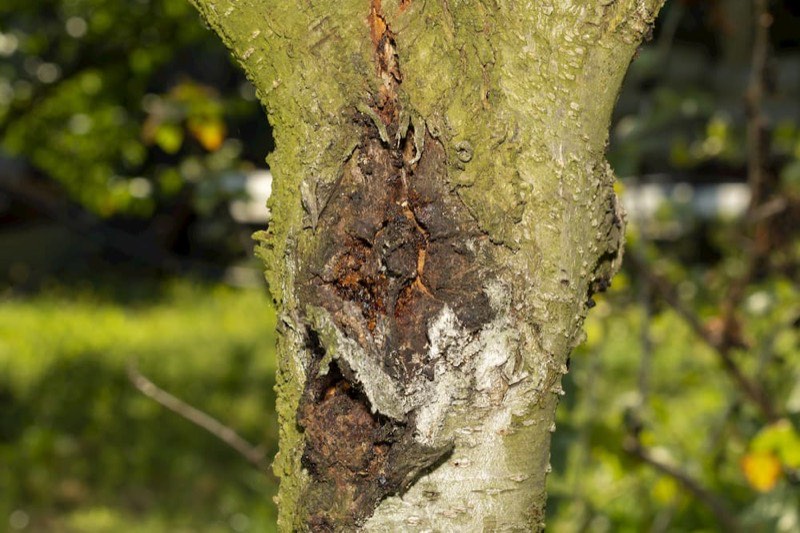
Bark sloughs off in patches revealing a grey-brown to black crust underneath, usually on an oak that has been struggling for a year or more. Hypoxylon is opportunistic: it colonises trees already failing from drought, root damage or construction injury. By the time the crust is visible the tree is rarely recoverable, and a hypoxylon tree over a target should be assessed for removal.
4. Root and collar rot — hidden at the base
Thinning canopy, small leaves, general decline with no obvious cause. Look at the base: is the root flare visible, or does the trunk go into the soil like a post? A buried flare stays wet and rots. Mushrooms or shelf fungus at the base mean established decay. This is the most under-diagnosed problem in urban trees and often the most fixable — sometimes with a shovel.
What not to do
Do not fertilise a sick tree reflexively. Unless a soil test shows a deficiency, fertiliser does nothing for disease and the nitrogen pushes soft growth a stressed tree cannot support. Do not prune oaks between February 1 and June 30 — that is how oak wilt gets in. And do not let anyone quote a removal from the kerb.
Get it identified
These four look broadly similar from a distance and need completely different responses: trenching, soil treatment, removal, or a shovel and an afternoon. Our Fort Worth diagnosis visit is free, and we will tell you if the answer is “nothing — water it”.
Tree Service Pros provides tree trimming, removal, stump grinding and land clearing across Tarrant, Johnson, Parker, Hill and Bosque Counties. Estimates are free — (817) 508-9940 or request one online.
More from the blog
Tree Surgeons in Fort Worth: What the Term Actually Means
“Tree surgeon” is a job description, not a credential. Here is what to look for instead when you are hiring someone to work on a tree in North Texas.
Read →Choosing a Tree Removal Company in Fort Worth: A Checklist
Tree removal produces more uninsured-loss disputes than any other home service. How to compare quotes, what should be in writing, and the questions that matter.
Read →Signs of a Sick Willow Tree in Arlington, Texas
Willows are fast, thirsty and short-lived in North Texas. The symptoms that mean treatment, the ones that mean removal, and why the species struggles here.
Read →Free estimate across five counties
Trimming, removal, stump grinding, land clearing and storm work.
Monday–Friday, 8:00 AM – 5:00 PM · Storm and hazard calls are answered outside office hours.